The Art of Artificial Jewelry Designing: Insights from Ahimanpur Jewellers
Have you ever looked at a stunning piece of jewelry and wondered about the complex story behind its creation? For centuries, jewelry design was an exclusive club reserved for those working with solid gold, platinum, and precious gemstones. But times have changed.
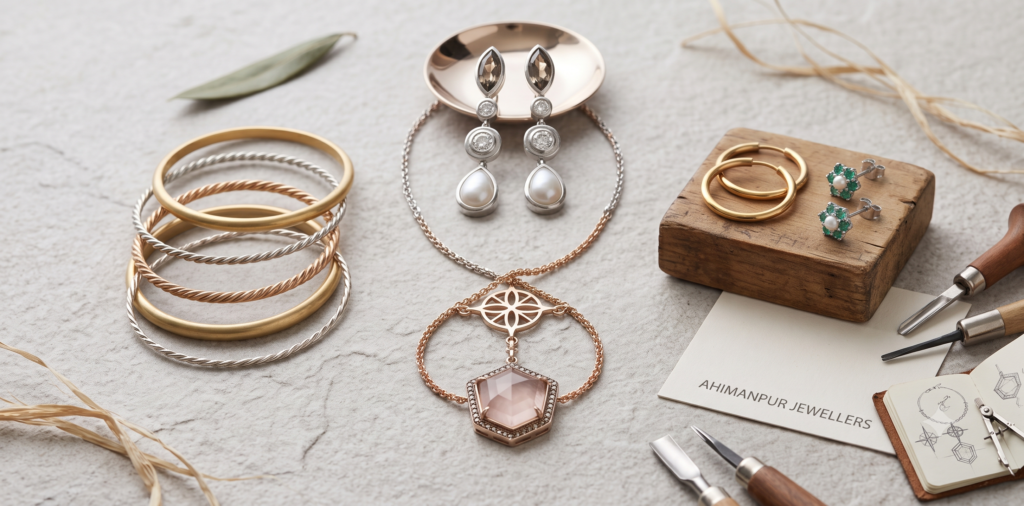
Today, artificial jewelry designing (often called fashion or costume jewelry design) is one of the fastest-growing segments in the global fashion industry. As an established jewelry manufacturer, Ahimanpur Jewellers has watched this industry evolve from simple replicas into an independent powerhouse of innovation, affordability, and limitless creative freedom. Modern designers are proving every single day that stunning style doesn’t require a mining permit.
Whether you are an aspiring designer looking to source a reliable manufacturing partner, an independent brand manager, or a jewelry lover curious about how your favorite pieces are engineered, this deep dive will uncover the manufacturing secrets behind modern artificial jewelry designing.
Why Artificial Jewelry is Having a Major Fashion Moment
Before we look at how it’s made, let’s talk about why artificial jewelry has taken over both runway collections and retail high streets alike.
In the past, costume jewelry was sometimes dismissed as a cheap alternative. Today, high-end artificial jewelry is celebrated for its technical innovation. At Ahimanpur Jewellers, we see several major factors driving this massive consumer shift:
- The Freedom to Experiment: Working with fine precious metals limits a designer because engineering mistakes are incredibly costly. Artificial materials allow designers to take massive creative risks with bold shapes, oversized silhouettes, and avant-garde concepts.
- Rapid Fashion Cycles: Trends move faster than ever before. Modern consumers want to update their seasonal style without spending thousands of dollars on fine metals.
- Travel-Friendly Style: More people are opting to leave their genuine heirloom diamonds in home safes and travel with high-quality replicas that look identical but offer peace of mind.
- Material Innovation: Thanks to modern manufacturing breakthroughs, base materials like brass, premium alloys, and lab-grown crystals can look just as brilliant as their high-end counterparts.
The Core Materials: Inside High-Quality Manufacturing
Designing great artificial jewelry starts with a deep understanding of your medium. Because you aren’t casting 24k gold, your manufacturing partner must utilize premium base metals and embellishments that offer real durability, luxurious weight, and long-lasting beauty.
1. The Base Metals
The base metal forms the structural skeleton of the entire piece. As a specialized jewelry manufacturer, Ahimanpur Jewellers utilizes three primary materials:
- Premium Brass: An alloy of copper and zinc. It is the absolute darling of premium fashion jewelry manufacturing because it is highly malleable (easy to shape), relatively affordable, and beautifully mimics the warm weight of real gold.
- Stainless Steel: Prized for its incredible structural durability and natural resistance to tarnish. It is completely hypoallergenic, making it perfect for everyday earrings and ring lines.
- Zinc Alloy: Frequently used for die-cast jewelry. It allows for intricate, highly complex details in bulk mass production but must be handled carefully to avoid brittleness.
2. The Plating (The Magic Finish)
Plating is the micro-layer of precious metal electroplated onto the base structure to give it its final color, luster, and protective barrier.
- Micron Gold Plating: High-quality artificial jewelry often uses micron plating, where a thick layer of real gold (usually 14k to 18k) is chemically bonded to the base metal. A thickness of 1 to 3 microns ensures the piece won’t quickly tarnish or fade.
- Rhodium Plating: Part of the platinum family, rhodium gives artificial jewelry a brilliant, scratch-resistant, silvery-white mirror finish that beautifully mimics white gold.
3. Embellishments and Stones
- Cubic Zirconia (CZ): A highly synthesized material that is visually close to a diamond but available at a fraction of the cost.
- Resin and Premium Acrylics: Perfect for bold, chunky, colorful retro designs where weight needs to be kept to a minimum for comfortable wear.
- Glass Crystals: Precision-cut lead glass engineered to reflect light exactly like natural gemstones.
The Production Process: From Sketch to Showcase
How does an idea in a designer’s mind turn into a retail-ready physical piece of jewelry? The production pipeline at Ahimanpur Jewellers blends old-world craftsmanship with cutting-edge digital technology.
Step 1: Mood Boards and Conceptualization
Every collection begins with a story. Designers rarely design individual pieces in a vacuum; they design collections (usually 5 to 15 pieces centered around a singular theme). Designers collect textures, color palettes, architectural references, and historical fashion images to establish a cohesive visual direction.
Step 2: Sketching and Technical Drafting
Once the concept is clear, the technical draft begins. This involves two critical design stages:
- Artistic Sketching: Quick, fluid gestures to capture the movement and feel of the piece on the human body.
- Technical Layout: Orthographic projections (front, side, and top views) with precise millimeter measurements, showing how clasps, hinges, and stone settings will function mechanically.
Step 3: CAD Modeling and 3D Printing
This is where modern technology shines. Using Computer-Aided Design (CAD) software specifically tailored for jewelry (like RhinoGold or MatrixGold), our engineers build a highly precise 3D digital model of the piece.
Once the digital file is perfected, it is sent to a high-resolution 3D resin printer. This prints a perfect 1:1 physical replica of the jewelry. Designers use this resin model to test the scale, check if a ring fits comfortably on a finger, or ensure a pendant sits perfectly flat against the collarbone.
Step 4: Casting and Molding
For mass manufacturing, the 3D-printed model is used to create a silicone or rubber mold.
- Liquid wax is injected into the mold to create multiple wax replicas.
- These wax models are assembled onto a wax tree and encased in a plaster-like material.
- The plaster is heated, melting away the wax (a process called lost-wax casting).
- Molten base metal (like brass) is poured into the resulting hollow cavity, creating the raw metal jewelry pieces.
Step 5: Polishing, Setting, and Plating
When the metal cools, it emerges rough and dull. Artisans use rotary tools, buffing wheels, and polishing compounds to smooth out imperfections until the metal shines like a mirror. Next, stones are meticulously set by hand or using micro-pave microscopes. Finally, the entire piece undergoes electroplating to receive its final coat of gold, rose gold, or silver.
4 Essential Rules for Designing Wearable Art
When you are working on artificial jewelry designing, it is easy to get carried away by pure aesthetics. However, jewelry is unique because it must interact intimately with the human body. Good manufacturing must balance form with function.
+-------------------------------------------------------------------+
|               THE FOUR GOLDEN RULES OF WEARABILITY                |
+-------------------------------------------------------------------+
|  1. THE WEIGHT FACTOR     | Earrings must stay under 10-12 grams   |
|                           | per lobe to prevent painful sagging.  |
+---------------------------+---------------------------------------+
|  2. BALANCE & CENTER      | Pendants must be balanced so they don't |
|     OF GRAVITY            | flip over forward when walking.       |
+---------------------------+---------------------------------------+
|  3. THE SNAG TEST         | Prongs and edges must be smooth so    |
|                           | they don't catch on delicate silks.   |
+---------------------------+---------------------------------------+
|  4. HYPOALLERGENIC BASES  | Strictly avoid nickel and lead to      |
|                           | prevent green skin and allergies.     |
+---------------------------+---------------------------------------+
Partnering with Ahimanpur Jewellers for Your Brand
If you are an independent designer or an online fashion brand looking to scale your inventory, finding the right manufacturing partner is the single most important decision you will make.
As an experienced jewelry manufacturer, Ahimanpur Jewellers helps brands bridge the gap between initial concept sketches and high-volume commercial production. We offer:
- Custom CAD development and rapid 3D prototyping.
- High-quality casting utilizing strictly regulated, lead-free and nickel-free brass and alloys.
- Premium micron gold plating and anti-tarnish protective coatings.
- Scalable bulk manufacturing capacities tailored to both growing labels and established retail chains.
By offloading the technical complexities of casting, stone setting, and electroplating to a dedicated manufacturer, you can focus 100% of your energy on marketing, brand identity, and customer acquisition.
Future Trends: What’s Next for the Industry?
The artificial jewelry industry is evolving rapidly, driven by changing consumer values. If you are designing for the future, keep these two massive shifts in mind:
Sustainability and Circular Materials
Eco-conscious consumers want to know exactly where their products come from. Forward-thinking artificial jewelry designers are shifting toward recycled brass, ocean plastic beads, and upcycled glass. Showing your audience that your beautiful designs don’t harm the planet is a massive competitive advantage.
Gender-Fluid Jewelry
The boundary between men’s and women’s jewelry has completely dissolved. Heavy chain links, pearl chokers for men, minimalist signet rings, and gender-neutral ear cuffs are dominating the market. Designing with inclusivity in mind opens your brand up to an entirely new demographic.
Conclusion: Unleash Your Creativity
At the end of the day, artificial jewelry designing proves that value isn’t determined solely by a price tag or a carat weight. True value comes from thoughtful design, emotional resonance, and exceptional craftsmanship.
By mastering your choice of materials, understanding how pieces interact physically with the body, and partnering with an experienced jewelry manufacturer like Ahimanpur Jewellers, you can transform your creative ideas into highly profitable, retail-ready collections. The canvas is small, but the creative possibilities are absolutely infinite.